Voice Whiz — Free Voice Analysis App
Voice Whiz is a free iOS app for real-time voice pitch analysis. It detects fundamental frequency (65–500 Hz), provides AI-powered gender perception feedback using on-device machine learning, and tracks vocal progress over time. Used by 300,000+ people for voice training, singing practice, and speech therapy support.
Free Voice Analysis – See Your Pitch in Real-Time
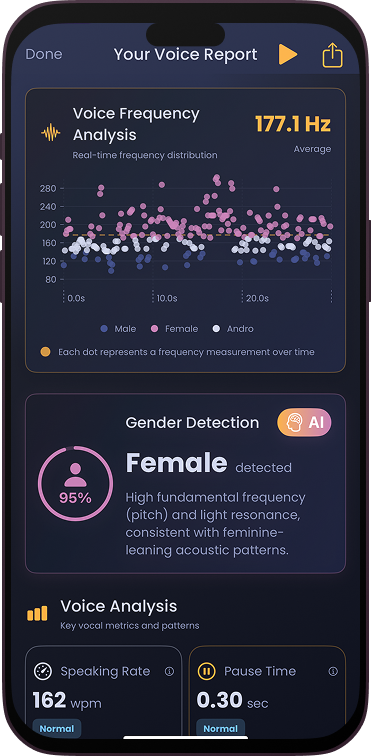
Voice Whiz is a free voice analysis app for iOS that visualizes your vocal pitch in real-time. The app measures your fundamental frequency (F0) in Hertz and displays it as a live graph, so you can see exactly where your voice sits as you speak or sing. It uses on-device machine learning and AI to analyze voice characteristics beyond pitch, including perceived gender. Whether you're training your voice for gender expression, improving your singing, or working with a speech therapist, Voice Whiz provides instant visual feedback.
Join 10,000+ people who practice their voice daily
Free to download • Real-time analysis • No sign-up required


Key Features
Who Uses Voice Whiz
Transgender Voice Training
The most popular use case. Trans women use Voice Whiz to practice voice feminization, targeting a pitch range of 165–255 Hz. Trans men track voice deepening over time, monitoring progress toward the 85–155 Hz masculine range. The AI gender detection provides real-time feedback on how the voice is perceived.
Singers and Vocal Coaches
Singers use the real-time pitch graph to improve intonation and stay in key. Vocal coaches use it as a visual aid during lessons to show students their pitch accuracy and range.
Speech Therapy Support
Speech-language pathologists and their clients use Voice Whiz as a supplementary tool to visualize pitch patterns during therapy sessions. The app provides objective pitch data that complements professional assessment. Note: Voice Whiz is not a medical device. For clinical voice concerns, consult a certified speech-language pathologist (ASHA).
Built-In Voice Training Library
Voice Whiz includes a comprehensive learn section with guided exercises and reading passages across 11 training categories:
Pitch Training
Guidance on finding your target speaking pitch and understanding pitch ranges. Learn what Hz values mean for your voice goals.
Resonance
Introduction to chest vs. head resonance and how vocal tract shape affects your sound. Understand the basics of tone placement.
Voice Feminization
Targeted exercises for MTF voice training: pitch elevation, resonance brightening, feminine intonation patterns, and speech rhythm practice.
Voice Masculinization
FTM voice training exercises: pitch grounding, chest resonance, masculine speech patterns, and voice projection techniques.
Breath Support
Diaphragmatic breathing, breath control, and sustained phonation exercises to build vocal stamina and consistency.
Articulation
Tongue twisters, consonant clarity drills, and exercises for crisp enunciation and mouth positioning.
SOVT Exercises
An introduction to Semi-Occluded Vocal Tract techniques like lip trills and humming — popular warm-up methods recommended by voice therapists.
Vocal Health
Warm-up routines, cool-down exercises, hydration tips, and guidance on avoiding vocal strain during training.
Performance & Presentation
Practice passages for public speaking, storytelling, and vocal expression. Build confidence with guided reading exercises.
Accent & Pronunciation
Exercises for vowel clarity, stress patterns, and prosody to improve pronunciation and communication skills.
Analysis & Metrics
Learn to understand your pitch data — what Hz ranges mean, how to read your voice graph, and how to set realistic training goals.
Voice Pitch Reference Ranges
Voice Whiz detects fundamental frequency (F0) across the full human speech range. These are the commonly referenced pitch ranges in voice research:
| Category | Typical Range | Average |
|---|---|---|
| Masculine speech | 85–155 Hz | ~120 Hz |
| Androgynous range | 155–165 Hz | ~160 Hz |
| Feminine speech | 165–255 Hz | ~210 Hz |
Pitch ranges based on published voice research. Individual voices vary. See Titze, I.R. (1994), Principles of Voice Production, and Gelfer, M.P. & Schofield, K.J. (2000) for reference data on speaking fundamental frequency.
What Makes Voice Whiz Different
| Feature | Voice Whiz | Typical Pitch Apps |
|---|---|---|
| AI gender perception analysis | Yes (on-device ML + AI) | No |
| Real-time pitch graph | Yes | Some |
| Recording with pitch overlay | Yes | Basic or none |
| Progress tracking over time | Yes | Rare |
| Downloads | 300,000+ | Varies |
What users are saying

"This app is truly amazing and has really helped me with my voice training."

"I found this useful for practicing my pitch. I recommend it."
"Great for tracking voice changes over time."
"The real-time analysis is incredibly accurate."
Frequently Asked Questions
What is Voice Whiz?
Voice Whiz is a free iOS voice analysis app that provides real-time pitch visualization and AI-powered gender detection. It measures your fundamental frequency (F0) in Hertz and displays it as a live graph. The app has over 300,000 downloads and a 4.4-star rating on the App Store.
Is Voice Whiz good for trans voice training?
Yes, Voice Whiz is widely used for transgender voice training. It provides AI-powered gender detection and real-time pitch analysis for both MTF voice feminization (targeting 165–255 Hz) and FTM voice masculinization (targeting 85–155 Hz). Users can save recordings and track vocal progress over time.
Is Voice Whiz free?
Voice Whiz is free to download on the iOS App Store with core features at no cost. Premium features are available via optional in-app purchases. No account or sign-up is required to get started.
How does Voice Whiz measure pitch?
Voice Whiz uses real-time audio processing to detect your fundamental frequency (F0) and displays it as a live pitch graph in Hertz (Hz). The app analyzes pitch continuously as you speak, giving instant visual feedback on whether you're within your target vocal range.
What voice range does Voice Whiz detect?
Voice Whiz detects vocal pitch across the full human speech range, from approximately 65 Hz to 500 Hz. This covers masculine speech (85–155 Hz), the androgynous range (155–165 Hz), feminine speech (165–255 Hz), and extended ranges used in singing.
Last updated: January 2026